SQL or MongoDB? Choosing a Database for Your Next Project
Both are mature and widely used. How to choose by looking at your data, your queries and your consistency needs, not at trends.
Learners starting their first full-stack project often ask whether they should use SQL or MongoDB. Both are mature, fast and used in production at every scale. The honest answer is that neither is better in general. The right choice depends on the shape of your data and how your application reads and writes it.
Start with your access patterns
Before choosing, write down the five or six most important operations your application must perform. For example: "show a customer's orders with the items in each", "list products in a category under a given price, sorted by rating", "add an item to a cart and reduce stock at the same time". These are your access patterns. They tell you more than any comparison chart.
How the two models differ
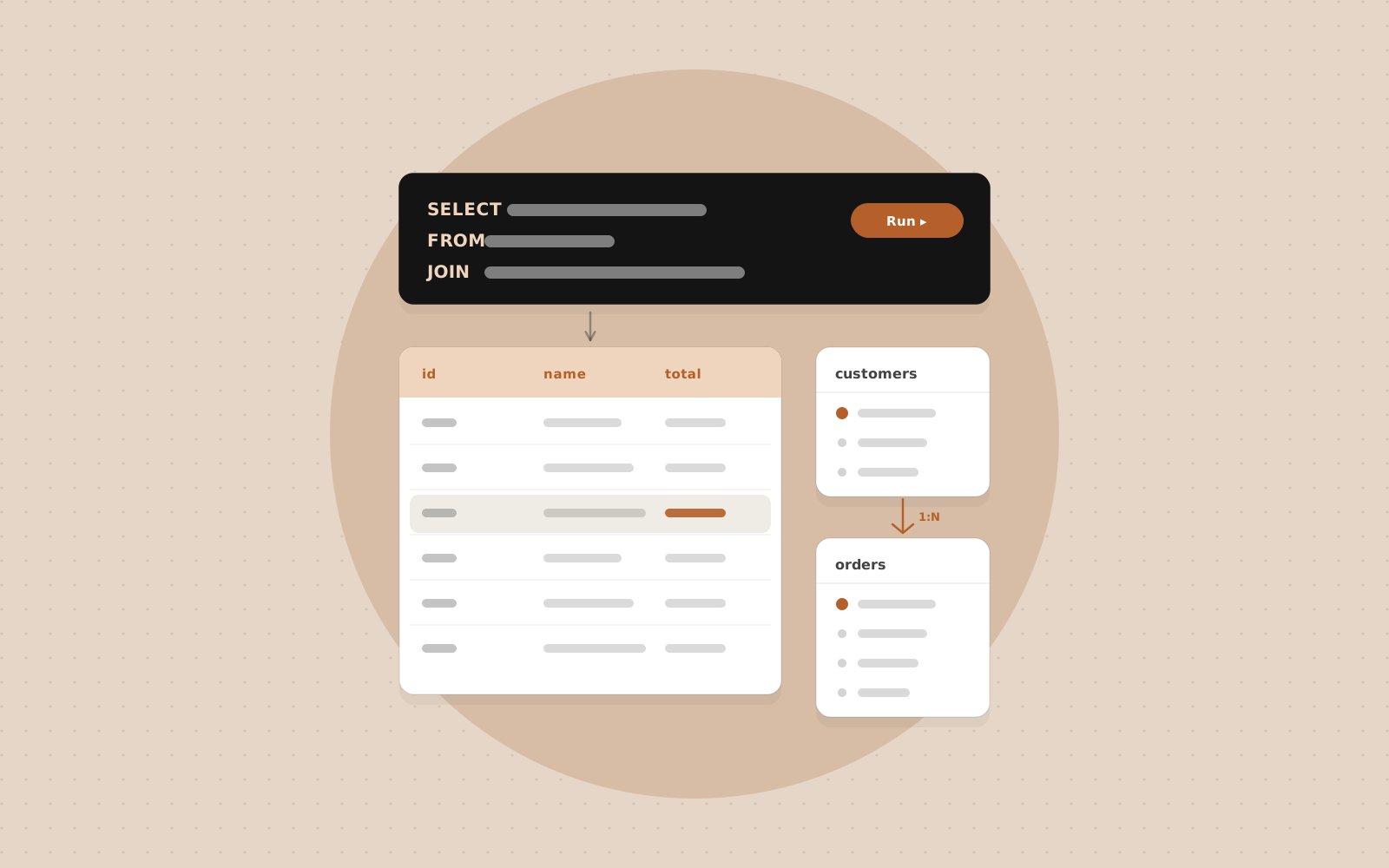
A relational database such as PostgreSQL or MySQL stores data in tables with fixed columns. Related data is split across tables and combined at query time with joins. A document database such as MongoDB stores JSON-like documents, and related data that is usually read together can be embedded in a single document.
The practical consequence: in SQL you normalise the data and let the query planner assemble it. In MongoDB you shape documents around your queries, deciding up front what to embed and what to reference.
When a relational database fits
PostgreSQL or MySQL is a sensible default when:
- Your data has many relationships, such as users, orders, products, payments and invoices, and you need to query across them in different ways.
- You need reporting, where joins, grouping and aggregation are routine.
- You want the database to enforce rules: foreign keys, unique constraints, check constraints and not-null columns.
- Transactions across several tables are central, as in accounting or inventory.
When a document database fits
MongoDB works well when:
- Data is naturally hierarchical and read as a unit, for example a product with its variants and specifications, or an article with its metadata and comments.
- Records genuinely differ in shape, such as a catalogue where each product type has different attributes.
- The schema is still changing quickly and you want to iterate without running a migration for every change.
Flexibility has a cost. Without a schema enforced by the database, your application code, or MongoDB's optional schema validation, has to keep documents consistent. Data that grows without bound inside one document, or that is duplicated across many documents, becomes hard to maintain.
Model your data around how it is read. Both databases reward that, and both punish ignoring it.
Common misconceptions
- "MongoDB has no transactions." It has supported multi-document ACID transactions since version 4.0. They are available, though designing documents so you rarely need them is usually better.
- "SQL can't handle flexible data." PostgreSQL's
jsonbtype stores and indexes JSON, so you can mix structured columns with flexible fields in one table. - "NoSQL scales and SQL doesn't." Both scale well for most applications. A single well-indexed PostgreSQL server handles far more traffic than most projects will ever see. Scaling problems usually come from missing indexes and poor queries, not from the database type.
Whichever you pick, learn indexes
Most slow queries are slow because they scan every row or document. Learn how indexes work, how to read a query plan (EXPLAIN in SQL, explain() in MongoDB) and which queries your indexes actually serve. This matters more to performance than the choice of database.
Rule of thumb: if you are not sure, choose PostgreSQL. It handles relationships, reporting and strict rules well, and its jsonb columns cover the cases where you need flexible fields. Choose MongoDB when your data is naturally shaped like documents, is mostly read and written as a whole, and the structure changes often. Many production systems use both, each for the job it suits.
Want to learn SQL properly?
Join a live, mentor-led cohort and build real projects. We reply within one business day.